
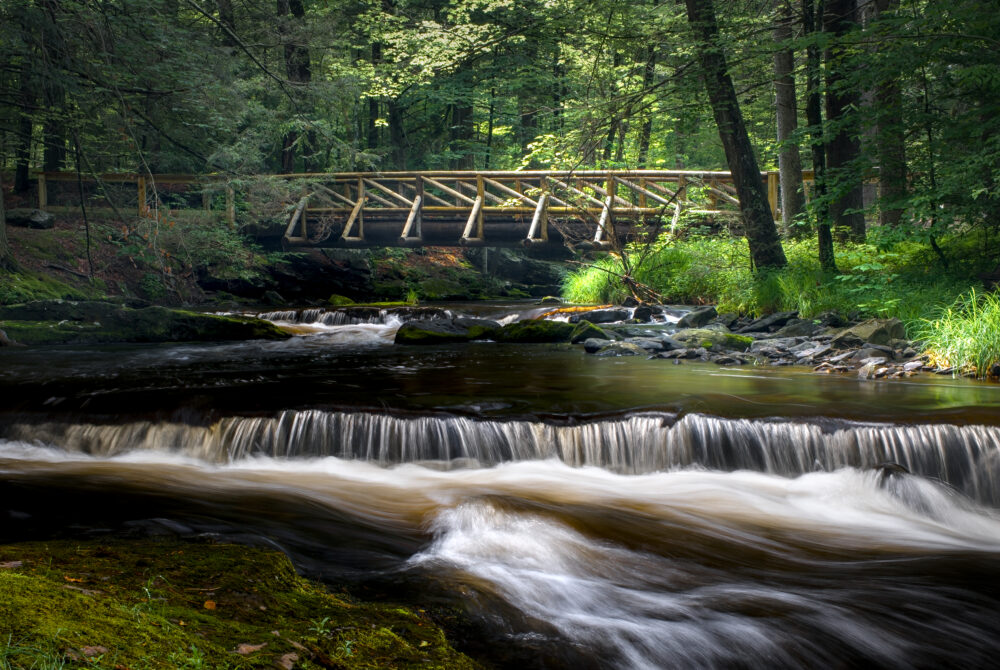
MrsFaceless and I visited George W Childs Park back in June to scout the three waterfalls – Fulmer Falls, Factory Falls and Deer Leap Falls. The plan would involve us returning in autumn to capture some stunning colours. However, due to work commitments MrsFaceless was unable to make the trip. For the revisit I would be running solo. Once I had started along the trail it was very quickly apparent that a storm had rolled through a day or so before and created a more apocalyptic scene than the one I wanted to showcase autumnal colours. With foliage and trees littering the landscape, large swaths of the autumn colours had been blown away.
When Plans Go Awry
Planning a landscape photography trip takes up a lot of time. Even when we have a full itinierary planned to the last detail, there are often a lot of locations which we simply don’t get to photograph. This can be due to timing, distance or, as happened recently, spurious beaurocratic decision beyond our control or even the weather. Checking various weather forecasts in the lead up to my return visit, nothing indicated anything other than a welcoming array of fall colours. That the autumn colours were blown away the day or so before I reached George W Childs park was a little frustrating.
George W Childs Park
George W Childs Park The Poconos’ Delaware Water Gap National Recreation Area boasts a hidden gem for photographers. It provides photographers and nature lovers alike, with three very nice waterfalls, some gorgeous natural beauty and a little man made history too. The waters here were used to power a wool mill and that building partially still stands to this day.
Location
You’ll find George W. Childs Park near Dingmans Ferry, Pennsylvania. It sits within the Delaware Water Gap National Recreation Area. It’s an easy drive from many spots in the Poconos. If you are visiting and get the chance, drive down to see, or cross, the bridge over the Delaware River. It’s privately owned with a nominal fee, but affords a good look along the river as well as access to New Jersey.
Bad Weather History
It’s worth noting that when it comes to landscape photography, the general tenet is ‘good weather is bad and bad weather is good’. There are, obviously, limits to how far this goes. But when it comes to George W Childs Park there is some history of having autumn colours blown away. And some. The park was closed in 2018 after a storm tore down thousands of trees, requiring a massive cleanup effort and rebuildng of the trails. It didn’t reopen until October 2024, a full six and a half years later. Gotta love government efficiency, eh?
Getting To The Falls
There are two paths from the car park to the start of the trail leading down, around and back up past the waterfalls. One path is ADA accessible, the other is more trail like. Both bring you out the the bridge over Dingmans Creek before the first of the waterfalls, Factory Falls. The trail itself is about 1.2 miles in length with an elevation change of 200 feet down and 200 feet back up. There are a lot of steps and staircases, but this should be manageable for anyone of average fitness. Just take your time!
Factory Falls
Factory Falls is a three tier, 18 foot drop waterfall. It’s fairly easy to get a good shot here as there is little in the way of deadfall or growth to hamper compositions. On our first visit we saw a good amount of water and some really nice bubble swirls. Sadly these didn’t translate into a good photo, but knowing that water swirls here brings hope for leaf swirl photos later in the year. If only autumn colours aren’t blown away!
Fulmer Falls
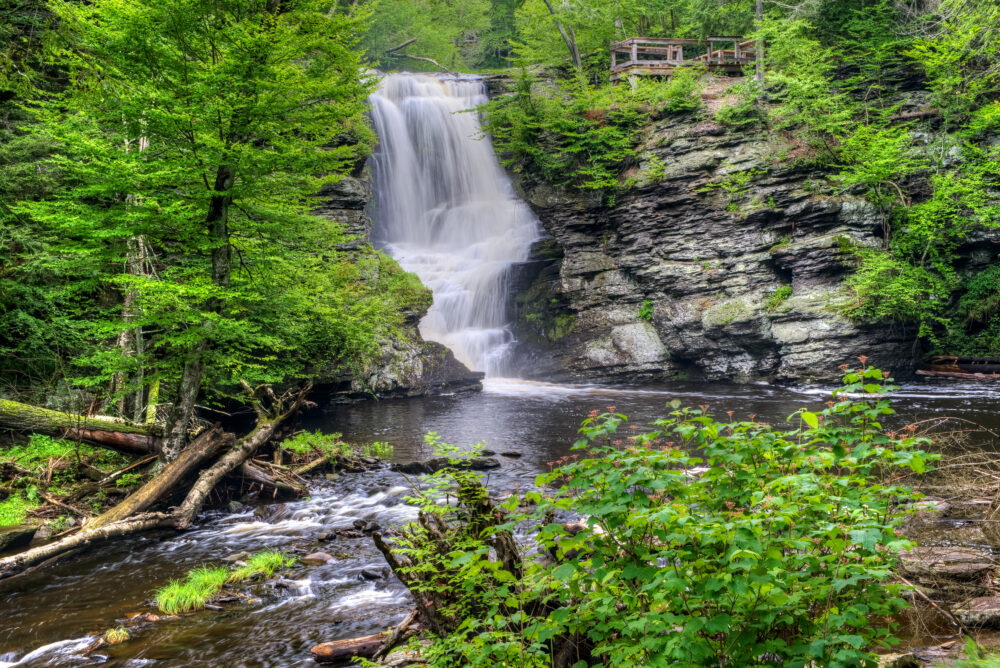
Fulmer Falls is the tallest of the three waterfalls at 56 feet. It is also the most difficult to photograph as there is no straying from the trail, making for a partially obscured view from the footbridge below, or an equally obscured view from the path to the side. The viewing gantry also has a fair amount of growth in front of it, including a double trunk tree.
Deer leap Falls
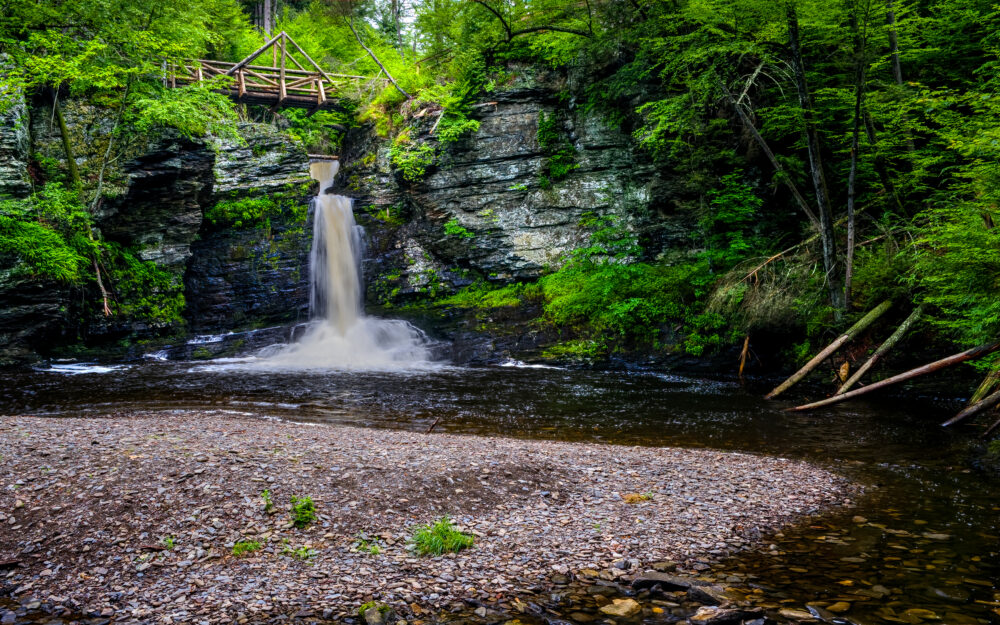
The final waterfall is Deer leap Falls. This is a 30 foot, narrow gorge like drop situated directly underneath an A-Frame bridge. This is my favourite of the three falls, being incredibly pretty and also offering a wide variety of compositions. The plunge pool in front of this waterfall is quite large and there are bubble swirls, logs and leaves as well as a few rocks making for ideal foreground and mid ground interest. The creek makes for a great leading line when there is decent water flow. Despite autumn colours being blown away on my latter visit, there was plenty of colour from the downed leaves scattered around the edge of the water.
Weathering the Storm
Always check the weather forecast before heading out to photograph. A bright, sunny day gives strong light and deep shadows. An overcast sky provides soft, even light, great for smooth water shots. Rain can make the greens around the falls pop, but it also makes trails muddy and rocks slippery. Be ready for whatever Mother Nature sends your way. Pack gear that can handle the elements.
Essential Gear Checklist for Waterfall Wonders
What should you carry for your waterfall photography adventure? A good camera body is key. Bring wide-angle lenses to capture the full scene. A telephoto lens can isolate details or distant falls. A sturdy tripod is a must for steady, sharp pictures. Don’t forget filters. An ND filter helps with long exposures and a CPL (circular polarizer) filter reduces glare. Extra batteries and memory cards ensure you don’t miss a shot. Pack lens cleaning cloths, too, as mist can get everywhere. If you have weather-sealed gear, even better!
Capturing the Motion: Techniques for Stunning Waterfall Photos
Now, let’s talk about how to take those breathtaking pictures. You can make the water look silky smooth or freeze its power. Both ways create stunning images.
Mastering the Art of the Long Exposure
Want that dreamy, silky water effect? Long exposure photography is your friend. This means using a slow shutter speed, sometimes several seconds long. Set your camera to a low ISO, like 100, to avoid noise. Choose an aperture, perhaps f/8 or f/11, for good depth of field. In bright light, an ND filter will help you use those slow shutter speeds. Mount your camera on a strong tripod to keep it still. A remote shutter release also helps prevent camera shake.
Freezing the Flow: Action Shots of Cascades
Sometimes you want to show the power of the water, not just its smooth flow. For this, use a faster shutter speed. This freezes the water droplets in mid-air. Try speeds like 1/250th of a second or even faster. This technique works well for showing the raw force of George W. Childs Park waterfalls. It highlights textures and details you might miss otherwise.
Compositional Secrets: Framing the Falls
Good composition makes your photos sing. Try the rule of thirds, placing the waterfall off-center for more interest. Look for leading lines, like a winding stream or fallen logs, to guide the viewer’s eye. Add foreground interest, maybe some mossy rocks or bright green ferns. Use wide-angle lenses to show the whole scene. A tighter shot with a telephoto can focus on just one part of the cascade. How you frame your shot changes the whole mood.
Beyond the Main Event: Photographing the Surrounding Scenery
Don’t just point your lens at the water. The area around George W. Childs Park waterfalls is full of beauty. Look for delicate ferns, vibrant moss, or unique forest trees. These details add to the story of your photos. Capture wide landscape shots that show the entire forested gorge. You might also spot some small critters or colorful wildflowers. These wider views give context to the stunning falls themselves.
Off-the-Beaten-Path Opportunities: Hidden Vistas
Sometimes, the best photos come from exploring a bit. You might find hidden vistas or unique angles by stepping slightly off the main path. Always be safe and respect park rules. Don’t go into areas that are blocked off. A little careful looking can reveal a unique photo spot that others miss.
Safety First: Trail Etiquette and Awareness
Safety is always most important. Trails near waterfalls can be very wet and slick. Wear sturdy, waterproof shoes with good grip. Watch for slippery rocks and roots. Always stay on marked trails to protect yourself and the park. Be aware of your surroundings, especially if you’re carrying heavy gear. Respect wildlife and leave no trace of your visit behind. Enjoy your Poconos hiking adventure responsibly.
Post-Processing Techniques for Fall Images
Paid Or Free Software
After capturing those stunning fall colours, it’s time to bring them to life in post-processing. By all means, pay for the photo editing software of your choice. MrsFaceless and I use a mix of paid and free software from an old version of Photoshop to Topaz DeNoise, Photomatix, Darktable and Gimp. The majority of our editing is now done in Darktable.
Conclusion
Despite having the best preparation, things may not go to plan. The key is to be adaptable and make good decisions in potentially diffuclt circumstances. As long as you are safe, keep exploring to find alternative compositions. Look out for vignettes rather than grander landscapes. But most of all, enjoy yourself and revel in whatever Mother Nature has to offer.